
Before diving into the ecommerce mobile app development process, it’s crucial to understand the fundamental concepts and options available. This includes deciding between native and hybrid apps, exploring no-code app builders, and understanding the costs involved.
Native vs. Hybrid Apps
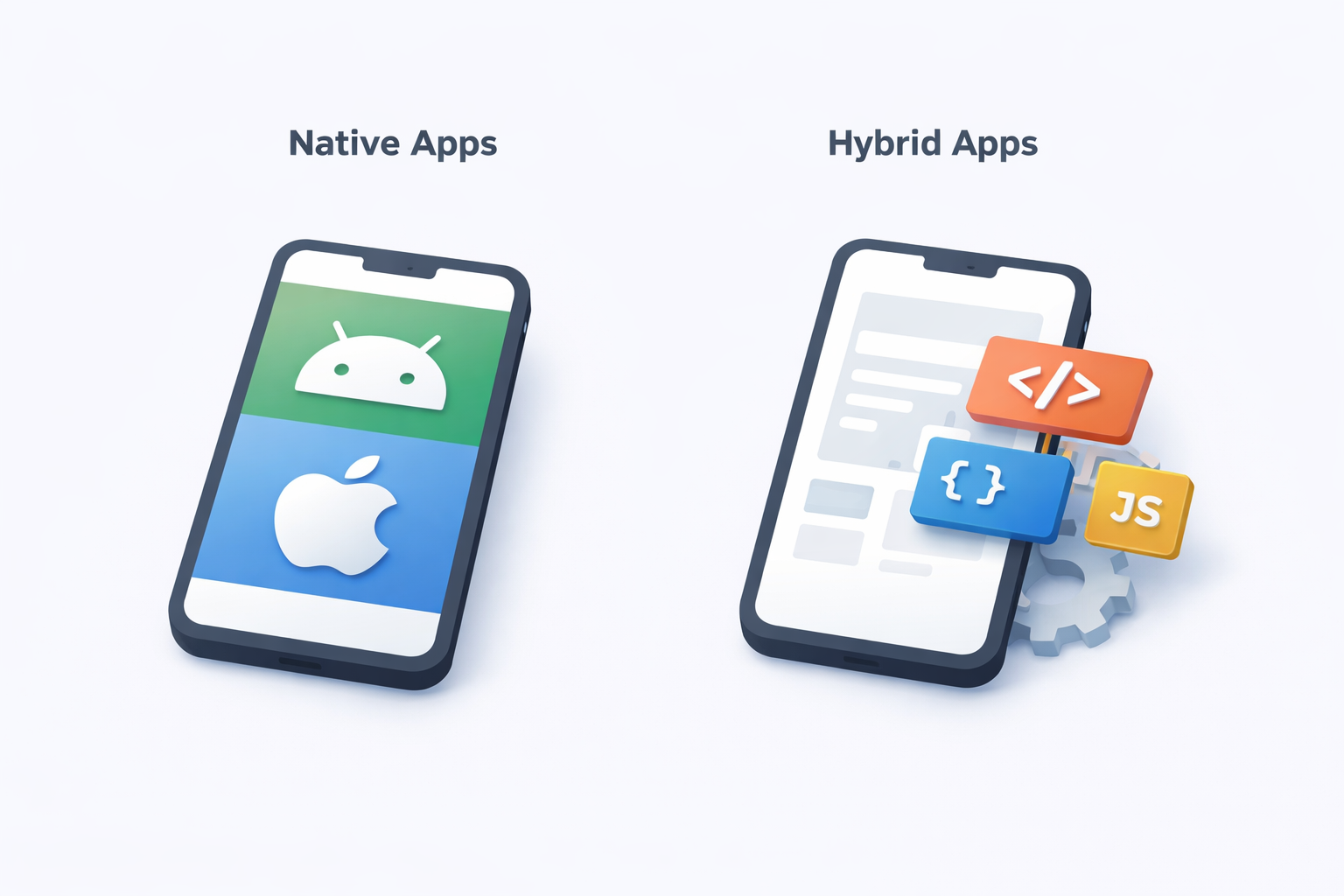
Native apps are built specifically for a particular operating system, such as iOS or Android, using platform-specific programming languages. They offer superior performance and a better user experience but require more time and resources to develop. The advantage of native apps lies in their ability to utilize device-specific features like camera access, GPS, and push notifications efficiently, thus enhancing user engagement.
Hybrid apps, on the other hand, are built using web technologies like HTML, CSS, and JavaScript. They can run on multiple platforms with a single codebase, making them faster and more cost-effective to develop. However, they may not perform as well as native apps. It’s important to weigh the pros and cons of each approach based on your business goals, budget, and time constraints.
Additionally, hybrid apps can be an excellent choice for businesses looking to enter the market quickly and test their app idea with minimal investment. They allow you to reach a broader audience without the need to develop separate apps for different platforms.
No-Code App Builders
For those with limited technical skills or budget constraints, no-code app builders like nandbox offer a viable solution. These platforms enable you to create mobile commerce apps without writing a single line of code. While they offer limited customization, they can be an excellent starting point for small businesses.
No-code app builders come with pre-built templates and drag-and-drop interfaces, making the app creation process intuitive and straightforward. They often provide essential features like user authentication, product listings, and payment gateways, which can be customized to some extent.
However, it’s crucial to consider the limitations of no-code platforms. As your business grows, you might need more advanced features and customizations that no-code platforms may not support. It’s essential to evaluate whether a no-code solution can scale with your business needs in the long run.
App Development Trends
Staying updated with app development trends is crucial for creating a modern, user-friendly app. Trends like AI-driven personalization, voice search integration, and augmented reality shopping experiences can set your app apart from the competition.
AI-driven personalization enhances user experience by providing tailored recommendations based on user behavior and preferences. Integrating voice search capabilities can make your app more accessible and convenient for users on the go, while augmented reality can offer immersive shopping experiences, allowing users to visualize products in their real-world environment.
Moreover, incorporating secure payment options, such as digital wallets and biometric authentication, can enhance user trust and drive conversions. Keeping an eye on emerging technologies and trends ensures your app remains relevant and competitive in the ever-evolving mobile commerce landscape.
Planning Your eCommerce Mobile App

A well-thought-out plan is the foundation of any successful mobile app. Consider these critical aspects during the planning phase:
Define Your Goals and Target Audience
Clearly outline what you want to achieve with your app and identify your target audience. Understanding your customers’ needs and preferences will help you design a user-friendly app that caters to their expectations. Defining clear goals will also guide your development process and help measure the app’s success post-launch.
Conducting market research and creating user personas can provide valuable insights into your target audience’s demographics, behaviors, and pain points. This information will inform your design and feature decisions, ensuring your app resonates with your intended users.
Aligning your app’s goals with your overall business objectives is crucial. Whether you aim to increase sales, enhance customer engagement, or expand your market reach, having a clear vision will keep your development efforts focused and aligned.
Competitor Analysis
Analyze your competitors’ apps to identify their strengths and weaknesses. This will help you learn from their successes and avoid their mistakes, giving you a competitive edge. Understanding what works and what doesn’t in the competitive landscape can inform your app’s unique value proposition.
Perform a detailed analysis of competitor apps to assess their user interface, features, pricing strategies, and customer feedback. Identify gaps in the market that your app can fill, and consider how you can differentiate your offering to stand out.
Competitor analysis also involves staying updated with industry trends and advancements. Regularly monitoring competitors’ updates and strategies will keep you informed about market dynamics and help you adapt your app to maintain a competitive advantage.
Choose the Right Features
Select features that align with your business goals and audience needs. Essential features for eCommerce apps include user registration, product catalog, shopping cart, secure payment gateway, order tracking, and customer support. Prioritizing features that provide value to your users will enhance their experience and drive engagement.
Consider integrating advanced features like personalized recommendations, wish lists, and customer reviews to enhance user interaction and satisfaction. Providing a seamless checkout process with multiple payment options can significantly reduce cart abandonment rates.
Additionally, ensure your app is equipped with robust analytics tools to track user behavior and gather insights for continuous improvement. Regularly updating your app with new features and enhancements based on user feedback will keep it relevant and engaging.
Budgeting for Development
It’s crucial to have a clear understanding of the costs involved in eCommerce mobile app development. Factors influencing the cost include app complexity, features, development team location, and platform choice. In India, the cost can range from $5,000 to $50,000, depending on these factors.
When budgeting, consider additional expenses such as app maintenance, marketing, and updates post-launch. Allocating resources for these aspects ensures your app remains functional and competitive over time.
Exploring cost-effective solutions, such as outsourcing development to regions with lower labor costs or using pre-built modules, can help manage expenses without compromising quality. A well-defined budget will guide your development process and prevent unexpected financial strain.
Designing Your Mobile App

by Tran Mau Tri Tam ✪ (https://unsplash.com/@tranmautritam)
Design plays a vital role in the success of your app. A visually appealing, user-friendly design can significantly enhance user experience and drive engagement.
User Interface (UI) Design
Focus on creating a clean, intuitive, and visually appealing UI that aligns with your brand identity. Ensure that navigation is seamless and users can easily find the information they need. Consistency in design elements, such as colors, fonts, and icons, enhances brand recognition and user trust.
Incorporate design principles that prioritize readability and accessibility, such as using high-contrast colors and legible fonts. Pay attention to the placement of interactive elements, ensuring they are easily tappable and intuitive to use.
Regularly test your UI design with real users to gather feedback and make necessary adjustments. A well-designed UI not only attracts users but also encourages them to explore and engage with your app.
User Experience (UX) Design
A positive UX is crucial for retaining users and encouraging them to make purchases. Prioritize fast loading times, easy navigation, and a smooth checkout process to enhance user satisfaction. Simplifying the user journey and minimizing friction points can significantly improve conversion rates.
Conduct usability testing to identify pain points in the user journey and gather insights for improvement. Analyzing user behavior and feedback will help you refine the UX and create a seamless, enjoyable experience for your users.
Consider incorporating features like one-click checkout, personalized recommendations, and easy access to customer support to enhance the overall user experience. Regularly updating your app with UX enhancements based on user feedback will keep it competitive and engaging.
Development Process
Choosing the Right Development Team
Selecting the right development team is crucial for your app’s success. Consider partnering with an experienced eCommerce mobile app development company like Brainvire, which offers custom app development and eCommerce app solutions tailored to your needs. A skilled team will ensure your app is built to high standards and delivered on time.
Evaluate potential development teams based on their expertise, portfolio, and client reviews. Ensure they have experience in developing eCommerce apps and understand the specific requirements of your industry.
Effective communication and collaboration with your development team are essential for a successful project. Establish clear expectations, timelines, and deliverables to ensure a smooth development process and achieve your app’s goals.
Development Methodologies
Choose a development methodology that suits your project requirements. Agile methodologies, such as Scrum or Kanban, offer flexibility and adaptability, allowing you to make changes during the development process. Agile development emphasizes iterative progress, ensuring continuous improvement and delivery of high-quality features.
Consider your team’s experience and project complexity when selecting a methodology. Agile methodologies are ideal for projects with evolving requirements, while traditional methodologies like Waterfall may be suitable for projects with well-defined objectives.
Regularly review and adjust your development approach to optimize efficiency and productivity. A well-chosen methodology will streamline your development process and ensure successful project completion.
Testing and Quality Assurance
Thorough testing is essential to ensure your app functions smoothly and is free of bugs. Conduct various tests, including functional, usability, performance, and security testing, to identify and fix any issues before launch. A rigorous testing process ensures your app meets quality standards and provides a seamless user experience.
Implement automated testing tools to streamline the testing process and identify issues more efficiently. Regularly update your testing strategies to incorporate new technologies and testing methodologies.
Gather user feedback during the testing phase to gain insights into potential improvements and enhancements. A robust quality assurance process will ensure your app is reliable, secure, and user-friendly.
Launching and Marketing Your App
Pre-launch Preparations
Before launching your app, ensure that it is optimized for app stores and meets all the necessary guidelines. Create a compelling app description, use relevant keywords, and design eye-catching visuals to attract potential users. A well-prepared launch strategy will maximize your app’s visibility and download rates.
Conduct thorough testing to ensure your app is bug-free and performs well under various conditions. Prepare a pre-launch marketing plan, including teaser campaigns and press releases, to generate interest and anticipation.
Collaborate with influencers and industry experts to expand your app’s reach and credibility. A successful pre-launch strategy will set the stage for a strong launch and initial user acquisition.
Marketing Strategies
Promote your app through various channels to reach your target audience. Consider using social media, email marketing, and influencer partnerships to generate buzz and drive downloads. A diversified marketing strategy ensures your app reaches a broad audience and maximizes its potential impact.
Develop engaging content, such as blog posts, videos, and infographics, to showcase your app’s features and benefits. Leverage user-generated content and testimonials to build trust and credibility with potential users.
Regularly analyze your marketing efforts to identify successful strategies and optimize your campaigns for better results. A well-executed marketing plan will ensure your app gains traction and attracts a loyal user base.
Analyzing User Feedback
After launching your app, gather user feedback to identify areas for improvement. Regularly update your app with new features and enhancements based on user suggestions to maintain engagement and satisfaction. Listening to your users and addressing their needs will foster loyalty and encourage positive reviews.
Implement in-app feedback tools to facilitate user feedback and gather valuable insights. Analyze user reviews and ratings to identify common issues and areas for improvement.
Create a roadmap for future updates and enhancements based on user feedback and market trends. Regularly engaging with your user community and addressing their concerns will ensure your app remains relevant and competitive.
Conclusion
Building an eCommerce mobile app is a strategic investment that can significantly boost your business’s growth and success. By understanding the basics, planning effectively, and focusing on design and development, you can create a user-friendly app that caters to your audience’s needs. Partnering with a reliable development company and staying updated with trends will ensure your app remains competitive in the ever-evolving mobile commerce landscape.
Regularly evaluate your app’s performance and gather user feedback to drive continuous improvement and innovation. A well-executed eCommerce app can enhance customer engagement, increase sales, and solidify your brand’s position in the market. Stay agile, adapt to changing market dynamics, and prioritize user satisfaction to achieve long-term success with your mobile app.
Q&A
How do I decide between building a native or a hybrid eCommerce app?
Choose native if you need top-tier performance, deep access to device features (camera, GPS, push notifications), and the best possible user experience—and you have the time and budget for separate iOS/Android builds. Go hybrid if speed to market and cost-efficiency are priorities, or if you want to validate an idea quickly with one codebase across platforms. Hybrid apps are faster and cheaper to develop but may not match native performance. Align the choice with your business goals, budget, timeline, and the complexity of features you need.
Are no-code app builders a good option for eCommerce, and can they scale?
No-code builders (e.g., nandbox) are a strong starting point for small teams or tight budgets. They provide templates, drag-and-drop UIs, and essential eCommerce features like authentication, product listings, and payment gateways—letting you launch quickly without writing code. The trade-off is limited customization and potential scaling constraints as your needs become more complex. Plan for the possibility of migrating to a custom build later if you anticipate advanced features, deeper integrations, or heavy customization.
What core features should my eCommerce mobile app include at launch?
Start with essentials that map to clear user value: user registration/login, a browsable and searchable product catalog, shopping cart, secure payment gateway, order tracking, and accessible customer support. To boost engagement and conversions, consider enhancements like personalized recommendations, wish lists, ratings/reviews, streamlined checkout (e.g., one-click), and multiple payment options (including digital wallets and biometric authentication). Build in analytics from day one to track behavior and inform continuous improvements; add trends like voice search or AR as they fit your audience.
How much should I budget for development, and what drives the cost?
Costs vary by complexity, feature set, platform choice (iOS/Android/native/hybrid), and team location. In India, eCommerce app development typically ranges from $5,000 to $50,000. Don’t forget ongoing expenses—maintenance, updates, and marketing—after launch. To manage costs, consider outsourcing to regions with lower labor rates, leveraging pre-built modules, and prioritizing a focused MVP before expanding features based on user feedback.
What’s the best way to launch and keep improving my app post-release?
Before launch, optimize for app stores with clear descriptions, relevant keywords, and compelling visuals, and ensure the app meets store guidelines. Run thorough testing, then build momentum with teaser campaigns, press releases, and influencer collaborations. Post-launch, market through social media, email, and content that showcases benefits and user testimonials. Continuously collect feedback (in-app tools, reviews), analyze usage data, and ship iterative updates guided by a public roadmap and emerging trends (e.g., AI-driven personalization). This cycle sustains engagement, trust, and competitiveness.