
Imagine building the world’s most beautiful store, complete with perfect lighting and stocked shelves, but placing it in the middle of a vast desert where no roads lead. This scenario mirrors the frustrating reality for thousands of creators who launch their software without a comprehensive application marketing strategy. The “Invisible Shop” problem explains why excellent tools often fail while average ones succeed simply because they built a path for customers to follow.
While developers often believe a great product sells itself, the mechanics of the App Store tell a harsher story. Industry statistics indicate that the vast majority of apps remain undiscovered not because they are broken, but because they are invisible to the algorithms that surface them. This distinction between product development and mobile application marketing —often just called application marketing—is often the deciding factor between a dormant hobby project and a sustainable business.
Even when users do stumble across your page, you have mere seconds to capture their attention. Your icon acts as a “digital handshake,” a first impression that instantly signals quality and relevance to a potential user. Mastering app marketing digital techniques (often shortened to app mkt) ensures that this critical “moment of discovery” converts a wandering eye into a confirmed install rather than a missed opportunity.
Yet, acquisition is only the beginning of the journey. Many businesses suffer from the “leaky bucket” effect, pouring resources into getting new users only to watch them vanish after day one. A successful app strategy —and broader app marketing strategy—must therefore solve the entire puzzle: making your app visible, winning the install, and giving users a compelling reason to return.
Key Takeaways
A full-funnel application marketing strategy makes your app discoverable (ASO), converts page views into installs (CRO), and retains users through value-first onboarding and thoughtful lifecycle messaging. Organic growth hinges on benefit-driven, keyworded titles, persuasive visuals, and review-fueled relevance, while retention improves with fast Aha! moments, just-in-time permissions, and tracking D7/D30 benchmarks. Scalable acquisition pairs efficient paid tests where CPI is below LTV with channel–message fit, plus trust-building via micro-influencers and referral loops. Measure what matters with attribution, Day-7 retention, and ARPU, and execute via a 90-day roadmap from ASO foundation to validated, profitable scaling.
Summary
This guide shows how a full-funnel application marketing strategy —spanning discoverability, conversion, and retention—turns an “invisible shop” into a sustainable business. It explains how to make the app store your best salesperson with ASO and CRO, grounded in mobile app marketing best practices : benefit-driven, keyworded titles, persuasive visuals, and review-fueled relevance to win organic search. It then addresses retention by fixing the “leaky bucket” via value-first onboarding, smart permissions, useful notifications, and clear benchmarks (e.g., Day‑7/30 retention). Finally, it covers efficient paid growth (CPI vs LTV, channel fit), trust-building via micro-influencers and referrals, rigorous attribution and metrics (install source, D7 retention, ARPU), and a 90‑day roadmap from ASO foundation to scalable acquisition—plus practical mobile app marketing ideas you can test quickly.
Turning the App Store into Your Best Salesperson
Imagine walking past a retail store with blacked-out windows and no sign above the door. You would likely keep walking, and that is exactly what happens when a mobile listing isn’t polished. This process is called App Store Optimization (ASO), which effectively acts as your digital window display. It ensures that when someone looks for a solution you offer, your “store” looks inviting enough to enter.
Getting found requires speaking the same language as your future users. If someone needs a way to organize their day, they will likely type “daily planner” into the search bar, not your clever brand name. By placing these specific search terms—or keywords—strategically within your text, you signal to the app store’s algorithm that your product is relevant to that user’s needs.
Visibility is only half the battle; you still need to close the deal. This is where Conversion Rate Optimization comes into play—the art of turning a casual browser into a confirmed download. Since most users make a decision based solely on the first two images they see, your screenshots must demonstrate value immediately rather than just showing a generic login screen.
To ensure your digital storefront is ready for business, focus on these four essentials:
- Clear Title: Include the main function of your app alongside the brand name.
- Descriptive Subtitle: Summarize your value proposition in one short sentence.
- Keyword-Rich Description: Weave common search terms naturally into your text.
- High-Contrast Screenshots: Use large text overlays on your images to explain key features.
With your storefront built, you are ready to focus on ranking.
Winning the Search Game: How to Rank Higher Without Paying a Cent
Consider the last time you needed a specific tool on your phone but didn’t know which company to trust. You likely searched for a solution, such as “workout timer” or “budget planner,” rather than a specific brand name. This behavior drives the majority of organic discovery, yet many developers mistakenly rely solely on their logo or name for visibility. As part of your app marketing strategy, pivot from describing who you are to describing what problem you solve, ensuring you appear when users are actively looking for help.
Optimizing your title involves more than just listing your name; it requires the “Benefit-Title” strategy. Instead of naming your product “FastCal,” a stronger entry would be “FastCal: Diet & Calorie Counter.” By appending the specific benefit directly to the name, you target users searching for those exact terms. This small adjustment is one of the most effective mobile app marketing techniques because it helps the algorithm categorize your product correctly while instantly telling potential users why they should care.
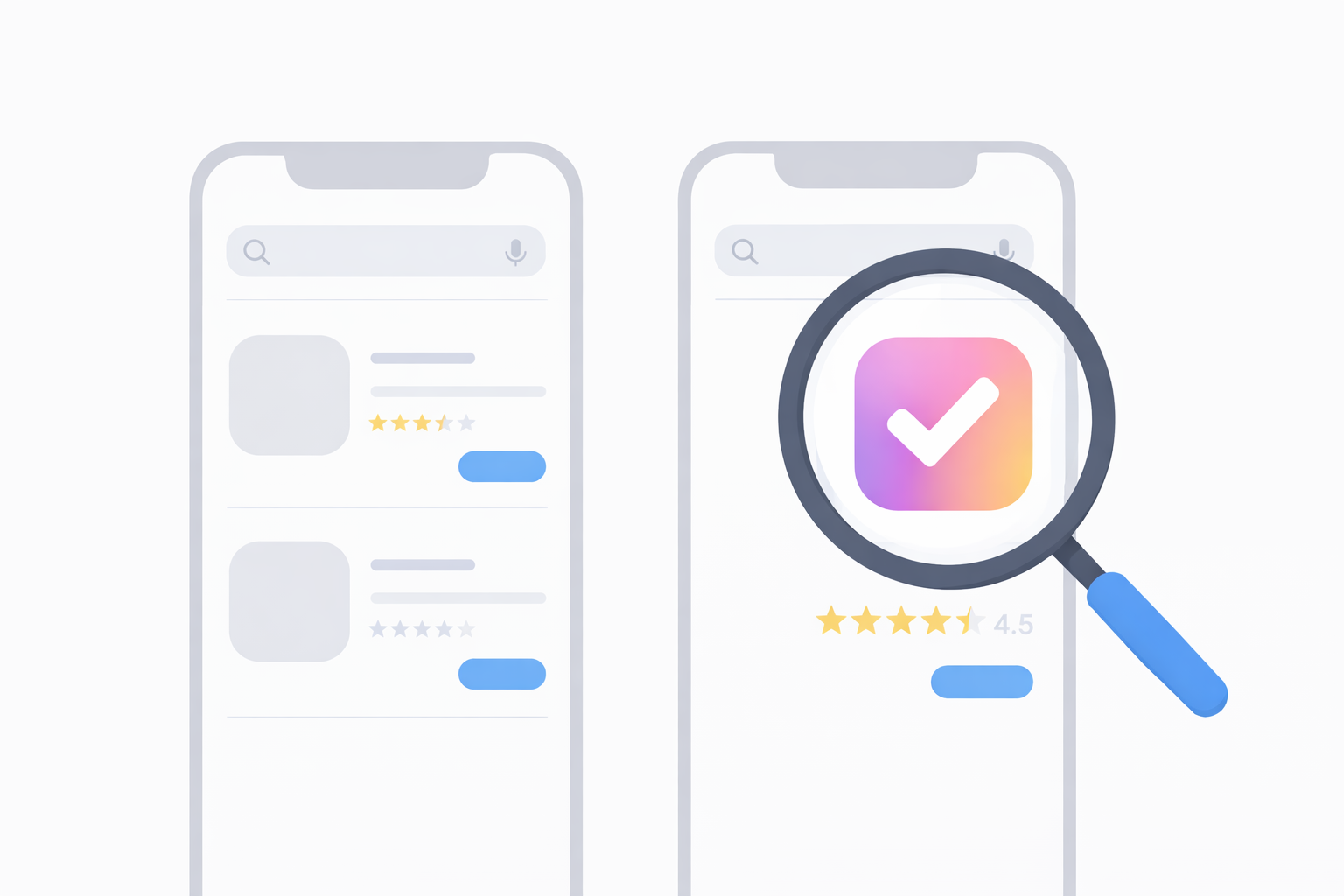
Ranking higher also depends heavily on what your current users are saying about you. App stores treat user reviews as a form of social proof, similar to how a busy restaurant attracts more customers than an empty one. When users leave reviews containing words like “easy to use” or “great for beginners,” the search algorithm begins to associate your software with those phrases. Encouraging satisfied users to leave feedback is a free way to build authority that paid ads simply cannot buy.
Mastering these search dynamics ensures a steady stream of new people finding your “storefront” every day without spending a fortune on ads. However, getting a user to download your product is only the first hurdle. Once they open the app, the real challenge becomes keeping them there.
Beyond the Download: Fixing the Leaky Bucket to Keep Users Forever
Imagine opening a busy restaurant where guests walk in, look around, and immediately leave before ordering. This is the reality for apps that focus only on downloads; they fill a bucket that is riddled with holes. In the industry, losing these users is called “churn.” If 1,000 people download your app but only 50 return, your hard work is wasted. Reducing mobile app churn rate starts by acknowledging that a download is just an introduction, not a commitment.
Fixing the leak requires optimizing the “onboarding flow,” which acts as your digital tour guide. Your goal is to rush the user to their “Aha! Moment”—that split second they realize exactly how your tool improves their life. Think of Duolingo; they let you translate a few words before asking for an email address. By delaying boring administrative tasks until after the user experiences value, you succeed in improving user onboarding flow.
A successful welcome sequence respects the user’s time while setting the hook. Structure your first few screens to hit these five critical touchpoints:
- The Welcome: A friendly greeting that reinforces they downloaded the right app.
- Single Value Proposition: One sentence reminding them of the main problem you solve.
- Smart Permissions: Ask for location or notifications only when necessary, explaining why.
- Core Feature Tour: A quick, interactive guide showing the primary button they need to press.
- Account Creation: The final step, ideally offered via “Sign in with Google/Apple” for speed.
Measuring success requires tracking “Retention Rate,” or the percentage of people who return after their first visit. Beginners often panic at drop-offs, but understanding what is a good app retention rate provides necessary context. In many categories, keeping just 20% of users after 30 days is considered a victory. You don’t need to keep everyone, just the users who find genuine utility in your product.
Once the first impression is secure, you need push notification engagement tactics that serve the user, not the business. Treat alerts like a tap on the shoulder from a helpful friend, not a salesman with a megaphone. A fitness tracker saying “You’re 500 steps away from your goal” is useful; one saying “We miss you” is just noise. Building a loyal base is the prerequisite for scaling up.
Smart Spending: How to Buy Your First 1000 Users Efficiently
Relying solely on word-of-mouth is like opening a store in a quiet alley and hoping people get lost. Paid acquisition is simply the act of renting a billboard on the main highway to direct traffic your way. It guarantees visibility, but it comes with a price tag that requires careful management to ensure you aren’t just buying attention, but actual business growth.
Before spending a dime, understand the relationship between cost per install vs lifetime value. Think of your marketing budget as a vending machine: if you put $2 in (the Cost Per Install, or CPI), you need to get at least $2.01 back over time (the Lifetime Value, or LTV). If a user costs $5 to acquire through ads but only ever spends $3 in your app, you are paying for the privilege of losing money.
Newcomers often fall into the trap of “spraying and praying” with large budgets immediately. Instead, treat your budget like a scientific experiment by starting with micro-campaigns of $5 to $10 a day. This low-risk approach allows you to test which headlines or images work best without burning through your capital, ensuring your mobile application marketing strategy is built on hard data rather than expensive guesses—and that your mobile app marketing campaigns can scale profitably.
Once you are ready to scale, choosing the right venue is critical. Not all mobile app user acquisition channels serve the same purpose, so select the one that matches your app’s specific utility:
- Search Ads (Google/Apple): Best for high intent. You catch users exactly when they are actively looking for a solution like “best vegan recipe app.”
- Social Media Ads (Facebook/Instagram): Best for specific targeting. Perfect for reaching niche groups, such as “Yoga enthusiasts aged 25-35,” based on their interests.
- Video Ads (TikTok/YouTube): Best for high engagement. Ideal for games or complex tools that need to demonstrate the experience to be understood.
Mastering these paid channels provides a reliable engine for growth, but traditional ads can sometimes feel impersonal. To add a layer of human credibility to your mobile app marketing strategies, many developers turn to voices that users already know and admire.
The Influencer Shortcut: Building Trust Through Familiar Faces
When you see a generic ad, you likely scroll right past it, but when a close friend recommends a product, you listen. This psychology is the foundation of effective influencer marketing for mobile applications. While many assume you need Hollywood celebrities or millions of followers to succeed, the most efficient marketing actually happens on a much smaller, more personal scale. It is often far better to have a yoga instructor with 5,000 dedicated followers recommend your meditation app than a famous pop star who creates zero actual engagement with your specific niche.
“Micro-influencers”—social media creators with modest but highly loyal audiences—offer a bridge of authenticity that traditional ads cannot match. Think of them as the trusted “regulars” at a local club; their opinion carries weight because they are viewed as peers rather than distant billboards. By partnering with creators who specifically cover your app’s topic, you ensure that every dollar spent reaches someone genuinely interested in your solution.
Trust does not just come from online personalities; your current users are actually your most potent sales force. To activate them, you need smart mobile app referral program ideas that create a “viral loop,” where one user brings in two more. Instead of paying cash for referrals, consider unlocking premium features or exclusive content for both the sender and the receiver, which adds value to their experience without draining your marketing budget. As you layer these mobile app promotion strategies on top of your paid ads, you will need a robust way to organize the flood of incoming performance data.
Connecting the Dots: How to Know Which Marketing Actually Worked
Imagine hiring three salespeople but pooling their sales into one register without recording who sold what. You would never know who to reward. Mobile attribution and tracking solves this by acting as a digital detective. Attribution tools assign a unique “fingerprint” to every link, so when a user downloads your app, the system matches them to the specific source. This clarity allows you to shift your budget toward channels that actually deliver results.
Seeing download numbers climb feels exciting, but focusing solely on installs is misleading. Just as a store cannot pay rent with window shoppers, a robust app marketing plan must distinguish between “Vanity Metrics” (total downloads) and “Actionable Metrics” (engaged users). You might find that Instagram ads bring in thousands who leave instantly, while a small email campaign brings fifty users who stay for years.
To ensure your mobile app marketing plan drives profit rather than hype, focus on these three indicators:
- Install Source: Identifies exactly which ad or partner brought the user in.
- Day-7 Retention: Tracks the percentage of users who return a week later, proving value.
- Average Revenue Per User (ARPU): Reveals the financial worth of each user.
With your measurement tools in place, you are ready to structure these tactics into a timeline.
Your 90-Day Roadmap to Application Marketing Mastery
You have moved past the fear of building an “invisible shop” in the digital desert. Effective app marketing isn’t about shouting into the void, but building reliable roads that lead users straight to your digital door. The difference between silence and traction is simply a matter of execution.
If you’re wondering how to market a new app , use this structure when developing a mobile app launch plan:
- Days 1-30 (The Foundation): Perfect your icon, screenshots, and keywords (ASO) before spending a dime.
- Days 31-60 (The Soft Launch): Gather initial feedback through organic social media and micro-influencers.
- Days 61-90 (The Growth Phase): Begin small paid ad experiments and fix any “leaky buckets” in user retention.
The best app marketing strategies are not about overnight viral success, but consistent improvement. Start simply. Look at your store listing tomorrow with fresh eyes—is it inviting? Your journey from a quiet launch to a bustling business begins with that single step.
Using No-Code Platforms: Execute Your Application Marketing Strategy Easily

When building an app, understanding marketing strategy is only half the battle, you also need the tools to implement it efficiently. No-code platforms such as nandbox offer creators the ability to launch iOS and Android apps without extensive coding while incorporating key marketing components directly. Knowing how to use such platforms helps illustrate how theory translates into practice: you can test marketing tactics quickly and gather real user data before scaling to full custom development.
With a platform like nandbox, you can:
- Test App Store Optimization (ASO): Adjust titles, descriptions, and screenshots in real-time to measure the effect on organic downloads.
- Experiment with onboarding flows: Build multiple variations of the first-run experience to optimize for user engagement and retention.
- Integrate retention strategies: Schedule push notifications, implement referral loops, and track Day-7/Day-30 retention metrics without writing a single line of code.
By combining your strategic planning with no-code experimentation, you can see what works before committing to a costly development cycle. This is particularly useful for the “Invisible Shop” problem, where even a well-designed app can fail if it isn’t discoverable or engaging enough to retain users.
Q&A
What is the “Invisible Shop” problem in app marketing, and how do I avoid it?
The “Invisible Shop” problem is launching a great app that no one finds because there’s no path leading users to it. Avoid it with a full-funnel strategy: make the app discoverable (ASO), convert page views into installs (CRO), and retain users (onboarding, useful notifications, and habit loops). Your icon and first visuals serve as a digital handshake that must communicate value in seconds. From there, align your title and description with what users actually search, use review-driven relevance to rank, and fix the “leaky bucket” by rushing users to an Aha! Moment so they return.
How should I optimize my app store listing to rank higher and convert more installs?
Treat your listing like a storefront window and optimize both for search and for persuasion using mobile app marketing best practices.
- Use a Benefit-Title: append the core outcome to your brand (e.g., “FastCal: Diet & Calorie Counter”) so you rank for problem-driven queries.
- Essentials to get right: Clear Title (function + brand), Descriptive Subtitle (one-sentence value prop), Keyword-Rich Description (natural language using terms users search), and High-Contrast Screenshots (large text overlays showing key benefits).
- Conversion hinges on the first two images—show value, not login screens.
- Encourage satisfied users to leave reviews; app stores use this social proof and even the language in reviews to understand relevance and improve ranking.
- Test simple mobile app marketing ideas such as seasonal screenshots or limited-time offers.
What does a strong onboarding and retention plan look like, and what’s a “good” retention rate?
Design onboarding to deliver value before friction and measure whether users return.
- Aim for the Aha! Moment fast (like Duolingo letting you try it before sign-up).
- Five key touchpoints: Welcome, Single Value Proposition, Smart Permissions (ask when needed and explain why), Core Feature Tour (quick, interactive), and streamlined Account Creation (Sign in with Apple/Google).
- Use helpful, context-aware push notifications (e.g., “500 steps to hit your goal”), not generic pings (“We miss you”).
- Track Retention Rate (Day‑7, Day‑30). In many categories, ~20% Day‑30 retention is a win. Optimize for the users who find genuine utility, not for keeping everyone.
How do I acquire my first 1,000 users efficiently with ads and influencers?
Make paid and creator-led efforts work together for your mobile app marketing campaigns, guided by unit economics.
- Know your numbers: CPI must be lower than LTV (you can’t pay $5 to earn $3).
- Start with micro-campaigns ($5–$10/day) to test headlines, images, and audiences before scaling.
- Match channel to intent: Search Ads (high intent), Social Ads (precise targeting), Video Ads (explain experiences like games or complex tools).
- Use micro-influencers for trust and relevance; niche creators often outperform celebrities for engagement.
- Activate referrals with value (unlock features/content for both referrer and friend) to create viral loops.
- Track creators and offers with unique promo codes so you know who truly drives installs.
How do I know which marketing actually worked, and what should my first 90 days look like?
Use attribution to connect installs to sources, focus on actionable metrics, and follow a staged roadmap.
- Attribution tools fingerprint links so you can see the Install Source and shift budget to what performs.
- Prioritize Actionable Metrics over vanity counts: Install Source, Day‑7 Retention (proof of value), and ARPU (revenue per user).
- 90‑day roadmap:
- Days 1–30: Nail ASO (icon, screenshots, keywords) before spending.
- Days 31–60: Soft launch via organic social and micro-influencers; gather feedback.
- Days 61–90: Run small paid tests and plug “leaky bucket” issues affecting retention. This cadence builds solid foundations, validates messaging, and scales only when economics and retention support growth.